Immune Rejuvenation via mRNA Thymic Factors — Liver as Thymus Substitute
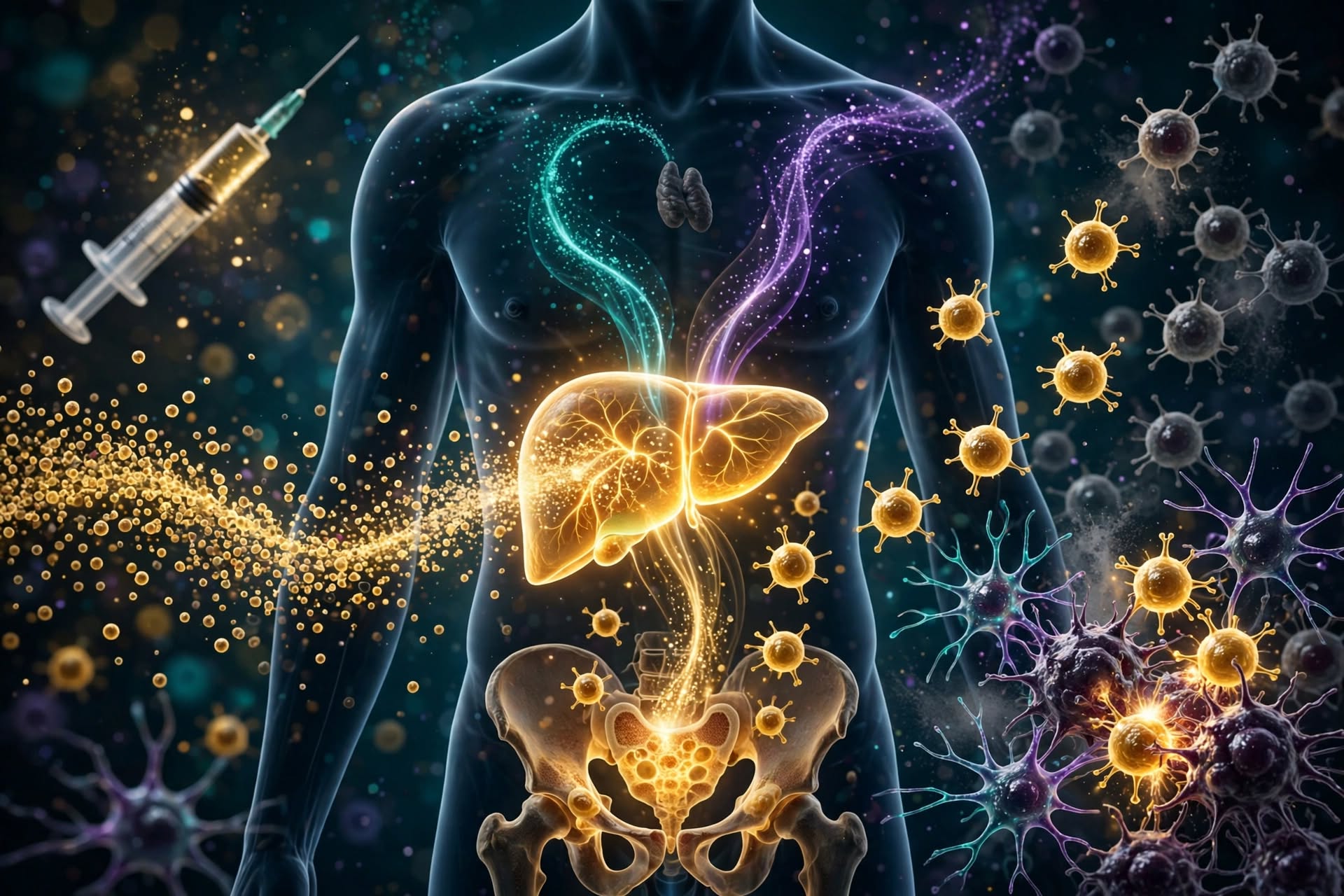
TL;DR: In Nature 2026, MIT / Broad researchers transiently repurposed the liver to restore aged immunity. mRNA-LNPs encoding DLL1, FLT3L, IL-7 (DFI) delivered to hepatocytes expanded common lymphoid progenitors, boosted de novo thymopoiesis without affecting HSC composition, replenished naïve T cells, enhanced dendritic cells, and improved vaccine and cancer immunotherapy responses in aged mice — with no autoimmunity. In parallel, AI CT analysis of 27,612 adults showed preserved thymic health predicts 50% lower mortality and 63% lower cardiovascular death.
1. The Denigma Prediction It Validates
In From Ageing to Rejuvenation, Denigma wrote:
There is a real rejuvenation process, sleeping in our genome. [...] I know it is possible to re-awake it also in our body cells!
ER-100 re-awoke it in the eye, direct conversion in blood-to-brain. This study re-awakes it in the immune system — without transplanting a thymus, without germline reset.
2. The Problem: Thymic Involution
The thymus is the primary organ responsible for generating naïve T cells, the cells that can respond to new pathogens and new tumor antigens.
But it is among the first organs to degenerate:
- Thymic involution starts in early adulthood and accelerates: naïve T cell production declines ~1% per year after age 35-45
- Mechanism: Thymic epithelial cell (TEC) attrition, FOXN1 decline, architectural disruption, oxidative damage (low catalase in stromal cells)
- Consequence: Constrained thymopoiesis, restricted T cell receptor (TCR) repertoire, compensated by homeostatic expansion of memory T cells — leaving older people less responsive to vaccines, more susceptible to new infections, and with diminished tumor surveillance
A thymus-centric perspective published in 2026 frames this as the principal constraint on de novo naïve T-cell production and TCR repertoire renewal. Clinically, constrained thymopoiesis may undercut vaccine responsiveness and reduce efficacy of cancer immunotherapies (CAR-T and immune checkpoint inhibitors) in older adults.
3. What MIT / Broad Did: DFI mRNA-LNP to Liver
Paper: Friedrich, M. J. et al. Transient hepatic reconstitution of trophic factors enhances aged immunity. Nature 650, 481-489 (2026).
- Lead author: Mirco Friedrich, former MIT postdoc
- Senior author: Feng Zhang, McGovern Institute, Broad Institute of MIT and Harvard, Howard Hughes Medical Institute
Design
- Factors: mRNAs encoding Delta-like ligand 1 (DLL1), FLT3L and IL-7 — collectively DFI — three key factors that usually promote T cell survival
- Delivery: Nucleoside-modified, LNP-packaged mRNAs, systemic administration, liver-targeted LNPs to hepatocytes
- Transient: Immunofluorescence of DLL1 protein over 0-48h after 5 µg DFI reveals transient induction in total liver and hepatocyte surface — expression fades, no permanent integration
- Logic: Instead of rebuilding the atrophied thymus, transiently repurpose the liver as a factory for thymus-derived trophic cues
Results in Aged Mice
Delivery of mRNAs encoding DLL1, FLT3L and IL-7 to hepatocytes expanded common lymphoid progenitors, boosted de novo thymopoiesis without affecting haematopoietic stem cell (HSC) composition, and replenished T cells while enhancing dendritic cell abundance and function.
- No HSC distortion: Boosted thymopoiesis without affecting HSC composition — a critical safety signal
- Vaccination: Significantly improved immune response in ageing mice in vaccination models
- Cancer: Improved anti-tumor immunity in cancer immunotherapy models, with no adverse side effects
- No autoimmunity: Work introduces a safe, transient approach to reversing immunosenescence by reconstituting a youthful signaling niche without inducing autoimmunity
This is not a thymus transplant. It is a signaling transplant — transient, controllable, reversible.
4. Why Thymic Health Matters in Humans: AI CT Data 2026
In parallel, two landmark Nature studies in March 2026 quantified thymic health in humans.
Bernatz et al., Nature 652, 986-994 (2026): Thymic health consequences in adults.
- Method: Deep learning framework to quantify thymic health from routine radiographic images
- Cohorts: National Lung Screening Trial (n = 25,031) and Framingham Heart Study (n = 2,581), total 27,612 adults, model developed on 5,674 CTs and validated on 27,612
- Findings: AI analysis reveals thymic health tracks with 50% lower mortality, 63% less cardiovascular death, and better immunotherapy outcomes
- Prediction: Functional thymic health forecasts risk of dying from cancer, cardiovascular, metabolic, and pulmonary disease over next 12 years, independent of age, sex, smoking history, and BMI
- Caveat: Findings are observational — correlation has not yet been established as causation
The thymus, long dismissed after puberty, may predict who lives longest and who responds to cancer treatment.
5. Industry: TECregen and Thymopoietics
On Jan 8, 2026, Basel-based TECregen raised CHF 10 million (~EUR 10.7M / USD 12.6M) in seed financing to advance a new class of thymus-rejuvenating biologics.
- Lead investor: Boehringer Ingelheim Venture Fund (BIVF), with LifeSpan Vision Ventures, Carma Fund, EOS BioInnovation, HTGF, JFG Life Sciences, Zurich Cantonal Bank
- Approach: Engineered biologics called thymopoietics, designed to regenerate thymic epithelial cells and rebuild the microenvironment required for effective T-cell production
- Status: No lead asset or clinical timeline disclosed yet — early stage, but validates thymus as druggable aging target
Friedrich DFI is orthogonal: TECregen aims to rebuild the thymus itself; DFI bypasses it via liver. Both converge on TEC / trophic factor niche.
6. How This Connects to Previous Denigma Posts
| Post |
Organ |
Mechanism |
Endpoint |
| ER-100 |
Eye |
AAV2-OSK, doxycycline 56d |
Glaucoma / NAION, first human partial reprogramming |
| Blood-to-Brain |
Brain |
Sendai SOX2 + cMYC, 50d |
iNSCs 80yo → <20y molecular age |
| GLP-1s |
Metabolism |
Semaglutide / Tirzepatide |
DunedinPACE -9% / 1.13→1.08 |
| This post |
Immune |
mRNA DFI to liver, transient |
De novo thymopoiesis, vaccine + tumor immunity |
Shared Denigma principle: Aging is plastic. Rejuvenation is information restoration, not germline reset.
GLP-1s hit inflammaging via mTOR; DFI hits immunosenescence via trophic niche. Together they cover two hallmarks that TEs post linked: inflammation and immune dysfunction.
7. What This Is Not
- Mice, not humans. No human DFI data yet. LNP delivery to human liver is feasible (COVID mRNA vaccines, patisiran), but dosing, durability, and safety in aged humans unknown.
- Not a thymus regrown. Thymus remains involuted; liver factory is transient, requires repeat dosing (frequency unknown).
- Observational human data. Bernatz AI CT association does not prove that improving thymic health extends lifespan.
- Autoimmunity risk theoretical. No autoimmunity in mice, but restoring naïve T cell output in aged humans with self-antigen exposure needs careful monitoring.
- Not lifespan extension. No survival data in Friedrich paper — vaccine and tumor models only.
8. Conclusion
Denigma defined itself as a Decipher Machine. In 2013 it deciphered heterochromatin → L1 → inflammaging. In 2026, it can decipher thymus → DFI → immune rejuvenation.
The liver can be transiently repurposed as a thymus substitute, using mRNA that fades in 48 hours, to restore what aging took: fresh naïve T cells, diverse TCR repertoire, vaccine response, tumor surveillance.
The jailbreak from germline-only reset is now in the immune system too.
References