Direct Blood-to-Brain Rejuvenation - 60 Years Rewound in a Dish
TL;DR: In October 2026, Bonn researchers directly converted red blood cell precursors from an 80-year-old donor into induced neural stem cells with a molecular age below 20 years - a 60-year rewind without passing through pluripotency. Using only SOX2 and cMYC via Sendai virus across 15 donors aged newborn to 101, the study shows epigenetic de-aging is protracted, trackable, and retains only ~13% of donor age at low passage and <5% after extended culture.
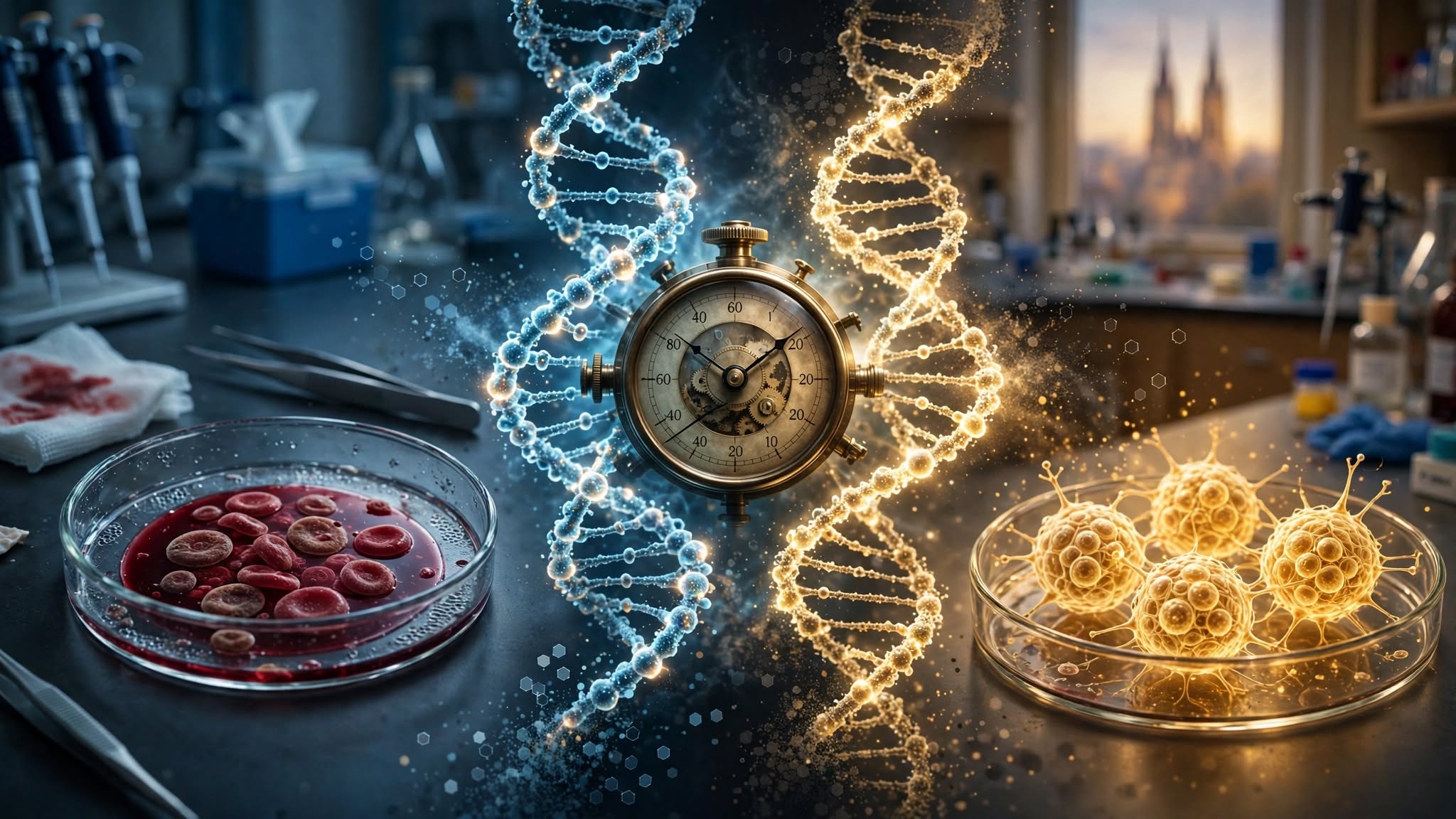
1. The Denigma Prediction It Validates
On May 31, 2013, Denigma wrote in From Ageing to Rejuvenation:
There is a real rejuvenation process, sleeping in our genome. It is activated as we pass our cells to the next generation. Therefore our children, regardless of which age we get them, have a restored lifespan. Ageing was truly reset. [...] I believe… no I know it is possible to re-awake it also in our body cells!
The Bonn study is the clearest in vitro demonstration of that re-awakening without germline transmission.
2. What Bonn Did
Researchers from the University Hospital of Bonn and University of Bonn, led by Oliver Brüstle at the Institute of Reconstructive Neurobiology, in collaboration with RWTH Aachen, directly reprogrammed red blood cell precursors into induced neural stem cells (iNSCs) from which neurons can be derived.
Key design:
- Starting material: Erythroid progenitor cells derived from easily accessible peripheral blood samples, specifically red blood cell precursors (CD71+).
- Reprogramming factors: Only two transcription factors, SOX2 and cMYC, delivered by Sendai virus - not the full OSKM Yamanaka cocktail and not even OSK used in ER-100.
- No pluripotency intermediate: Direct transdifferentiation, bypassing induced pluripotent stem cell (iPSC) stage, reducing teratoma risk.
- Cohort: 15 donors spanning newborn to 101 years of age, demonstrating technique works even at extreme age.
- Timeline: Conversion tracked over ~50 days, from downregulation of erythroid marker CD71 within days to emerging neural stem cells by day 12.
The work was published as "Protracted Fate Acquisition and Epigenetic De-Aging During Induced Neural Stem Cell Conversion of Human Blood Cells" (DOI: 10.1111/acel.70751).
3. How Much Younger? The Numbers
Using Horvath's skin-and-blood epigenetic clock and related DNA methylation clocks to estimate molecular age:
- 80-year-old donor example: Blood precursors transformed into stem cells with a molecular age of less than 20 years.
- Quantitative retention: At low passage, converted iNSCs retained about 13% of donor chronological age; after extended culture, under 5%.
- Slow-motion erasure: Epigenetic age was not instantly reset but gradually erased, allowing researchers to track cellular dynamics as cells forget their age.
- Up to 101 years: Blood cells from donors aged up to 101 straight into neural stem cells and watched their molecular age fall away over a hundred days.
For an 80-year-old, this represents >60 years of epigenetic de-aging in a dish - the headline "From 80 to 20 Years Old in the Lab" used by the university.
4. Why Direct Conversion Matters
Versus iPSC reprogramming
Classic Yamanaka reprogramming (2006) overexpresses four genes to strip somatic cells back to a blank pluripotent state, which resets age to near zero but also erases identity and risks tumorigenicity. Direct conversion retains lineage restriction - blood to brain stem cell - without ever becoming pluripotent.
Versus partial reprogramming in vivo (ER-100)
ER-100, the first human partial reprogramming trial cleared by FDA on January 28, 2026 and first dosed June 9, 2026, uses AAV2-OSK with doxycycline control for glaucoma and NAION. Bonn's approach is orthogonal: in vitro, two factors only, no AAV integration, observable day-by-day de-aging.
Together, they show two routes to the same Denigma principle: epigenetic information can be restored without germline reset.
5. Mechanism: Protracted Fate Acquisition
The title's first half is crucial. Unlike rapid iPSC formation, fate acquisition is protracted:
- Days 0-3: Downregulation of erythroid marker CD71 after Sendai SOX2/cMYC infection
- Day 12: Emerging iNSC colonies with early neural markers
- Days 12-50: Gradual loss of blood transcriptional program and gain of neural stem cell program, with epigenetic clock rewinding in parallel, enabling a controllable window to study how cells forget age
This slow window is a feature, not a bug - it provides a model to dissect rejuvenation drivers versus mere dedifferentiation.
6. What This Is Not
The authors and university press releases are explicit:
The result is a measurement in laboratory-grown cells - not evidence that the donor, their brain, or their body became younger, and not a treatment demonstrated in people.
- Not lifespan extension, not dementia treatment, not brain rejuvenation in vivo
- Molecular age measured by clocks (DNA methylation, transcriptomic) is a biomarker, not functional youth
- Cells were not transplanted back; no functional neuron data from 80-year-old iNSCs in patients yet
- Still requires viral delivery (Sendai, non-integrating but transient)
7. Conclusion
Denigma defined itself as a Decipher Machine for the plastic nature of aging - that aging can be sped up, slowed down, stopped, or reversed because it is encoded, not inevitable. In 2013 that was philosophy. In October 2026, blood from an 80-year-old (and even a 101-year-old) became brain stem cells with molecular age <20 in 50 days, using two factors, trackable in slow motion.
The jailbreak from germline-only reset is now in a dish. The next step is to make it safe in situ - exactly what ER-100 attempts in the eye, and what direct conversion models enable for the brain.
References