Revisiting Transposable Elements: From Denigma Hypothesis (2013) to Human Gerotherapeutics (2026)
TL;DR: In 2013 Denigma predicted that HIV reverse transcriptase inhibitors could suppress LINE-1 retrotransposons for anti-aging effects. In 2026, a randomized human study shows tenofovir alafenamide (FTC/TAF) reduces epigenetic age (DunedinPACE -0.061, PhenoAge -6.33y), while mechanistic studies confirm L1 cDNA drives inflammation via cGAS-STING.
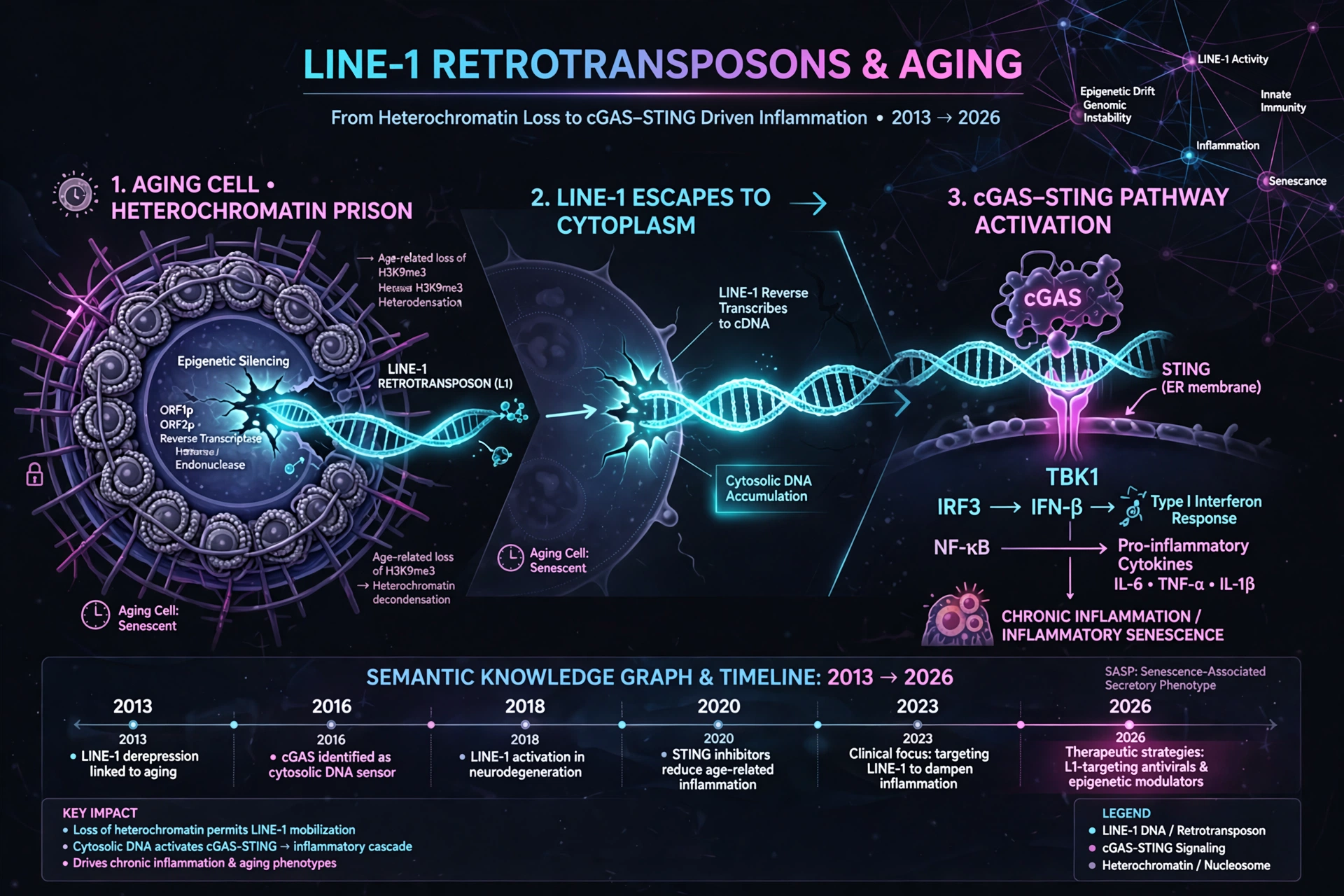
1. The 2013 Denigma Prediction
On February 8, 2013, Denigma created the entry Transposable Element:
Transposable Elements are mobile strands of DNA that insert themselves into Chromosomes (Jumping Genes) with mostly harmful consequences. Cells try to keep them locked down, but Aging cells lose their ability to maintain this control. [...] Cells try to clamp down on transposons by winding and packing transposon-rich regions around nucleosomes. This confining arrangement makes up the heterochromatin, and the DNA trapped in such a tight heterochromatin prison cannot be transcribed. [...] Chromatin changes profoundly with Aging. Young and spry cells distinctly maintain open euchromatin where essential genes are located and closed heterochromatin around active transposable elements. The distinction becomes worn in senescent cells.
And the therapeutic foresight:
Drugs might be able to suppress transposons in Aging cells. Virtually all the transposons of concern in mammals are retrotransposons because they use RNA and an enzyme to copy themselves. Certain HIV drugs inhibit this reverse transcriptase. The reverse transcriptase of the major human retrotransposons L1 are inhibited by some HIV drugs widely used in the clinic. Drugs that highly specifically target L1 might be considered to be tested for anti-Aging effects.
This tuple was never closed — until now.
2. Mechanism: LINE-1 → cGAS-STING → Inflammaging
2024-2025 literature has converged on a precise pathway:
- Only L1 is autonomous: Among retrotransposons, long interspersed nuclear elements (LINE-1, or L1), Alu, SVA, and ERVs dominate, but L1 remains the only autonomous active TE in humans, encoding ORF1p and ORF2p essential for retrotransposition.
- Epigenetic erosion with age: The epigenetic landscapes that maintain TE silencing erode with age, resulting in reactivation of otherwise quiescent elements.
- Cytoplasmic cDNA as danger signal: During cellular senescence, LINE-1 is transcriptionally derepressed. Cytoplasmic LINE-1 cDNA activates type-I interferon response via the cGAS DNA sensing pathway and STING (ER membrane). This is the late senescence phenotype that maintains SASP.
- Suppression: The nucleoside reverse transcriptase inhibitor lamivudine downregulates activation of type-I interferon and age-associated inflammation in tissues.
This directly validates the original ontology: Aging -causes-> Derepression of Transposable Elements → Derepression -causes-> Inflammation.
3. Evidence Timeline: 2013 → 2026
| Year |
Milestone |
Source |
| 2013 |
Denigma: LINE-1 derepression linked to aging, proposes NRTIs |
denigma.de |
| 2016 |
cGAS identified as cytosolic DNA sensor |
Literature |
| 2018 |
LINE-1 activation in neurodegeneration |
Literature |
| 2020 |
STING inhibitors reduce age-related inflammation |
Literature |
| 2024 |
Neuron-predominant ORF1p and LINE-1 RNA increase with aging in mouse and human brain |
|
| 2025 |
ARDD presentation: LINE-1 knockdown in mice reduces inflammation, extends lifespan, preserves fertility |
|
| 2025 |
Review: LINE-1 drives age-associated inflammation via cDNA-STING/IFN, lamivudine suppresses it |
|
| 2026 |
First human proof-of-concept: FTC/TAF reduces biological age; ARPA-H $22M for TPN-101 |
|
4. Murine and Cellular Data
Steady-state neuron-predominant LINE-1 encoded ORF1p protein and LINE-1 RNA increase with aging in mouse and human brain, with significant increase in young LINE-1 elements including those with open reading frames in human post-mortem dopaminergic neurons.
At ARDD 2025, Dr. Andrei Seluanov presented data showing that knockdown of LINE1 retrotransposons in mice reduced inflammation, extended lifespan, and even preserved fertility beyond typical reproductive windows — sparking interest in reverse transcriptase inhibition.
5. Human Proof-of-Concept 2026: Tenofovir Alafenamide Reduces Epigenetic Age
Study Design
Two separate randomized, directly observed dosing pharmacokinetic studies in healthy people without HIV (aged 18-50):
- FTC/TAF study (Descovy, 200 mg / 25 mg) N=36, 12 weeks
- FTC/TDF study (Truvada, 200 mg / 300 mg) N=43, 12 weeks
Evaluated DNA methylation-based measures of biological aging.
Results: FTC/TAF
- DunedinPACE -0.061, p=0.019 — reduced pace of aging
- PhenoAge -6.33 years, p=0.008
- Concordant reductions across additional systems-specific epigenetic clocks including those estimating brain aging
- Epigenetic IL-6 -0.058, p=0.029 and trend CRP -0.231, p=0.059
Results: FTC/TDF
No significant changes across epigenetic clocks and proxies. Consistent with TAF's more favorable cellular pharmacology (tenofovir-diphosphate accumulation).
Early mechanistic work showed that multiple NRTIs including 3TC (lamivudine), tenofovir disoproxil fumarate (TDF), stavudine, and zidovudine can directly suppress human LINE-1 retrotransposition in cell-based reporter systems.
Translation
Transposon Therapeutics announced ARPA-H awarded up to $22 million to study TPN-101 (nucleoside RT inhibitor) for extending healthy aging under PROSPR, aiming to reduce excessive interferon signaling by inhibiting retrotransposon reverse transcription.
8. Conclusion
Denigma was defined as a Decipher Machine. In 2013 it deciphered that heterochromatin loss → L1 escape → inflammation might be drugable with existing antivirals. In 2026, the decipher machine has scaled from a bigdata-backed semantic app to billion-triple knowledge graphs, but the core logic held.
The jailbreak is real. The drugs to suppress it are already FDA-approved. The ontology now has a human endpoint.
References